The Pilot & His Aircraft
Josef Bernat was a pilot for the whole of his professional life — from the trainers of the Prostějov academy through bombers and transport aircraft to his post-war service in the Royal Air Force. This page follows his path through an airman's eyes: the machines he flew, and what he achieved in them.
Beginnings: Prostějov and Air Regiment 1
He learned to fly at the Military Aviation Academy in Prostějov, the principal nursery of pilots in inter-war Czechoslovakia (the Air Force Youth School, pilot branch), where trainees of the 1930s flew types such as the Praga E-39 and E-41, Aero biplanes and the Letov Š-16.[6], [28] From the mid-1930s he served with Air Regiment 1 “T. G. Masaryk” at Prague-Kbely, and in 1937 he completed a course in blind and night flying — a skill that would later decide between life and death on night raids over Germany.[6] After his escape to France he passed through the retraining bases of Avord, Istres and Châteauroux; the fall of France came before he could fly in combat there.[6]
Vickers Wellington — the aircraft he trusted with his life
The fateful type of Josef Bernat's war was the British twin-engined bomber Vickers Wellington (No. 311 Squadron flew the Mk.Ia and Ic). Its designer Barnes Wallis gave it a unique geodetic structure — a lattice of some 1,650 duralumin members covered with fabric, in which the members shared each other's loads: Wellingtons therefore came home with the fabric burned away and lattice members severed. It was powered by two 1,000 hp Bristol Pegasus XVIII radial engines and carried a crew of six.[20] It was precisely the Wellington's toughness — and the crew's cool heads — that decided the night of 5/6 July 1941, when wireless operator Rudolf Haering beat out the flames in the fuselage with his bare hands and Bernat's burning aircraft made it home from Münster. The repaired R1532 went on to serve with a training unit and survived the war.[10], [26]
With No. 311 Squadron he flew 40 operational sorties (189 hours 11 minutes) in Wellingtons against targets in Germany and occupied Europe.[2]
The aircraft documented under his name:
-
R1532 · KX-R
Wellington Mk.Ic R1532
His aircraft on the Münster raid of 5/6 July 1941 — attacked by a night fighter, the burning wing extinguished by the crew in flight, and with the hydraulics shot out Bernat belly-landed it at East Wretham. This flight earned him the DFM.[10]
-
R3237 · KX-C
Wellington Mk.Ic R3237
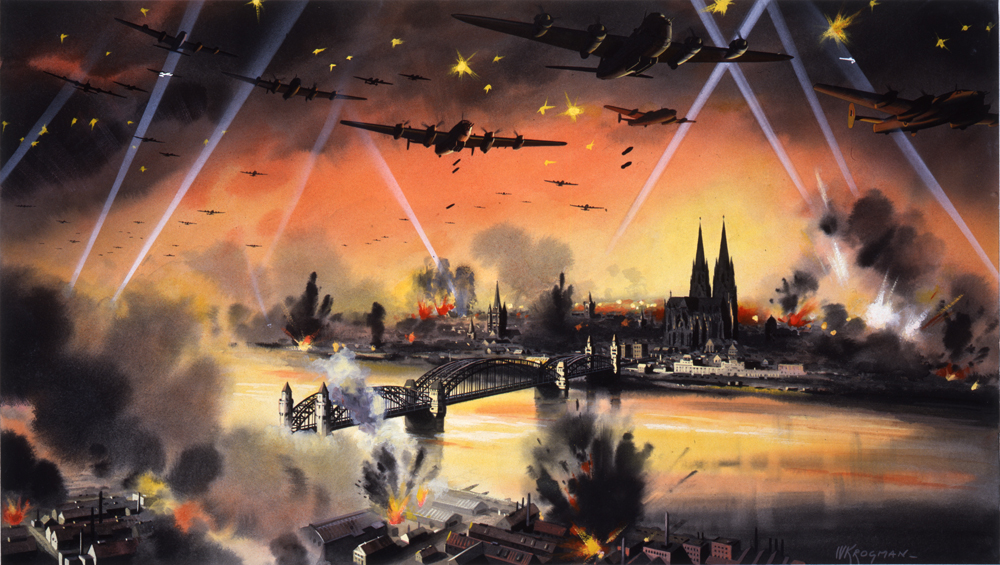
In this machine, in S/Ldr Breitcetl's crew, he took part in Operation Millennium on 30/31 May 1942 — the first thousand-bomber raid, against Cologne.[7]
-
Z8854 · KX-V
Wellington Mk.Ic Z8854
As captain he flew it on the second thousand-bomber raid, against Essen, on 1/2 June 1942.[11]
Teaching others to fly: East Wretham and Canada
After completing his operational tour he passed on his experience as a flying instructor — in 1942 with No. 1429 (Czechoslovak) Operational Training Flight at East Wretham, which trained new crews for 311 Squadron. It was this unit's crews that joined the thousand-bomber raids on Cologne and Essen in which Bernat took part.[23], [7] He then taught flying in Canada, where much of RAF pilot training had moved under the Allied training scheme. In the summer of 1944 he returned to Britain and until the end of the war flew with RAF Transport Command from the bases of Lyneham and Holmsley South, from which Czechoslovak transport pilots flew the Liberators, Yorks and Dakotas of Nos. 511 and 246 Squadrons.[1], [6] The specific types of those years are not yet documented for Bernat by name — here too we await his personal file.
Airline captain: Kbely, ČSA and the Romanian trail
Back home he served with the Air Transport Regiment at Prague-Kbely, which flew C-47 Dakotas and Junkers Ju 52/3ms and, besides routine transport, carried out state flights with the republic's highest officials.[6], [27] In 1947, during a twelve-month leave of absence, he joined ČSA, the Czechoslovak state airline, as a transport pilot — ČSA then flew Douglas DC-3s and had operated a Prague–Bucharest route since late 1946.[6], [24]
This is most likely where the Romanian episode belongs: in 1947 Romania awarded him two decorations — the National Order of the Star of Romania and the Gold Cross of the Order of Aeronautical Virtue (Virtutea Aeronautică, abolished by the communist regime as soon as 1948).[1], [6] Such a combination was typically bestowed on the crews of government and official flights — everything therefore suggests Bernat flew between Prague and Bucharest, whether on the transport regiment's state flights or the ČSA route. Direct proof is still missing; his service record at the Military Central Archives should hold the answer.
Douglas C-47 Dakota — the aircraft of the escape
The Douglas C-47 Skytrain (“Dakota” in RAF service), the military version of the legendary DC-3, was the most widespread Allied transport aircraft of the war[21] — and for Bernat it became the machine of the flight of his life. In the small hours of 14 June 1948 he “borrowed” Dakota 43-48406 from Kbely, reportedly reserved for President Gottwald's use, and with 21 refugees aboard flew it in radio silence to RAF Manston on the last drops of fuel.[3]
The Dakota itself has a remarkable epilogue: after three months of negotiations Britain returned it to Czechoslovakia — complete with an invoice for its maintenance at Manston. It then flew in civil markings as OK-WZA with the Aeronautical Research and Test Institute in Prague, later in Germany (D-CABE), with Israel Aircraft Industries (4X-AOA), in the USA and Colombia (N95BF), ended up with the Colombian police as PNC-211, and flew its last on 18 February 2009 at Medellín — outliving its captain by nine years.[3], [25]
A second RAF career (1948–1970)
In Britain he rejoined the RAF and served for another twenty-two years. He retired on 1 October 1970 as a Flight Lieutenant retaining the rank of Squadron Leader.[15] What exactly he did in the post-war RAF — and whether he still flew actively — is the subject of further research in the British archives; he lived at Whatton, just a few miles from RAF Newton.
This page is being completed as research continues: the UK National Archives (AIR 27 — No. 311 Squadron operations record books) and the Military Central Archives in Prague (service record, aviation card) hold the complete list of types Josef Bernat flew and the details of his post-war service.